Showing posts with label China. Show all posts
Friday, September 24, 2010
China, overview
* the blog entries from Tibet are not included here as we consider Tibet NOT to be really part of China.
** the journal of our travels in Nepal - India will follow shortly.
Thursday, September 23, 2010
The historical city of Xi An
Our overnight train from Beijing arrived with Swiss punctuality to Xi An, one of China's most busiest railway stations. There were millions and millions of people all around. After we managed to get rid of the crowd, taxi drivers, vendors and our big backpacks (no no no, they weren't stolen, only placed safely? in the luggage room), we were finally on our way to explore the Terracotta Army and the city afterward.
Xi An has a lot to offer besides its main attraction, the awesome Army of Terracotta Warriors... for example, the Ancient Wall which, at 13km length, it is the longest surviving city wall:
Outside the walls - where most of Xi An's 8 million inhabitants live - poverty and dirt, inside - traditional towers & pagodas mixed with ultramodern shopping malls and remains of very poor neighborhoods of the ancient city hidden behind luxory hotels. Traffic was just as chaotic as everywhere in China, but suddenly the people seemed to be calmer and friendlier (some of them were even giving us directions in English!)
Hungry enough after a long day, we wandered around the Muslim quarter (in fact, pushed ourselves through the masses of people, trying in the meantime to avoid being hit by motorcycles, bikes, rickshaws and animals), looking for Xi An's famous noodles.
There was plenty of street food, we have to admit though, that it was quite an adventure dining here. You can never know WHAT is inside the pot, HOW it's been prepared and HOW you are supposed to eat it. The positive thing is, that food is extremely cheap, so you can try out everything and eat what you like... (we still returned hungry to the hotel and waited for our next day's breakfast).
All our pictures on Xi'An
Xi An has a lot to offer besides its main attraction, the awesome Army of Terracotta Warriors... for example, the Ancient Wall which, at 13km length, it is the longest surviving city wall:
| From ASIA - CHINA - Xi An |
Outside the walls - where most of Xi An's 8 million inhabitants live - poverty and dirt, inside - traditional towers & pagodas mixed with ultramodern shopping malls and remains of very poor neighborhoods of the ancient city hidden behind luxory hotels. Traffic was just as chaotic as everywhere in China, but suddenly the people seemed to be calmer and friendlier (some of them were even giving us directions in English!)
![]() |
| From ASIA - CHINA - Xi An |
Hungry enough after a long day, we wandered around the Muslim quarter (in fact, pushed ourselves through the masses of people, trying in the meantime to avoid being hit by motorcycles, bikes, rickshaws and animals), looking for Xi An's famous noodles.
| From ASIA - CHINA - Xi An |
There was plenty of street food, we have to admit though, that it was quite an adventure dining here. You can never know WHAT is inside the pot, HOW it's been prepared and HOW you are supposed to eat it. The positive thing is, that food is extremely cheap, so you can try out everything and eat what you like... (we still returned hungry to the hotel and waited for our next day's breakfast).
All our pictures on Xi'An
Location:
Xi'an, Shaanxi, China
Wednesday, September 22, 2010
The Terracotta Army of the 1st Emperor of China
In 1974, peasants digging a well uncovered perhaps the most important archaeological discovery of the 20th century - thousands of life-sized terracotta soldiers and their horses in battle formation of Qin Shi Huang, the 1st Emperor of China (dating from 210 BC!!!).
The first vault houses about 2000 soldiers, with approximately 6000 more soldiers yet to be uncovered.
Apparently we are awaiting technology to improve enough where the colors painted on the warriors can be preserved. Once exposed to air the colors fade over time:
It's a breathtaking view! Different body types, different faces, different military ranks.
Unfortunately hundreds of soldiers had been smashed by previous dynasties, so it is no small task putting them all together, especially considering that each soldier is unique. It is like you would take hundreds of jigsaw puzzle boxes, mix all the pieces and then put all them together without having pictures of what the result should be: good luck. (oh, did I forgot to mention we are talking about 3d puzzles of course)
However, not only soldiers were built, but also armor and for example a four horse war chariot with mounts of the Emperor:
All our pictures of the Terracotta Army
| From ASIA - CHINA - Xi An |
The first vault houses about 2000 soldiers, with approximately 6000 more soldiers yet to be uncovered.
| From ASIA - CHINA - Xi An |
Apparently we are awaiting technology to improve enough where the colors painted on the warriors can be preserved. Once exposed to air the colors fade over time:
| From ASIA - CHINA - Xi An |
It's a breathtaking view! Different body types, different faces, different military ranks.
| From ASIA - CHINA - Xi An |
Unfortunately hundreds of soldiers had been smashed by previous dynasties, so it is no small task putting them all together, especially considering that each soldier is unique. It is like you would take hundreds of jigsaw puzzle boxes, mix all the pieces and then put all them together without having pictures of what the result should be: good luck. (oh, did I forgot to mention we are talking about 3d puzzles of course)
| From ASIA - CHINA - Xi An |
However, not only soldiers were built, but also armor and for example a four horse war chariot with mounts of the Emperor:
| From ASIA - CHINA - Xi An |
All our pictures of the Terracotta Army
Labels:
Asia,
China,
Terracotta Army,
Xi An
Location:
Xi'an, Shaanxi, China
Tuesday, September 21, 2010
The Ming tombs
After the hike on the Great Wall, we visited the Ming tombs, a complex of burial sites of the Ming dynasty with the largest tomb for emperor Yongle (the 3rd emperor who lived in the 15th century):
The so called Spirit Way lined with a series of statues of guardian animals and officials leading to the burial complex is an attraction by itself:
All our photos of the Ming tombs
| From ASIA - CHINA - The Great Wall & Ming Tombs |
| From ASIA - CHINA - The Great Wall & Ming Tombs |
The so called Spirit Way lined with a series of statues of guardian animals and officials leading to the burial complex is an attraction by itself:
| From ASIA - CHINA - The Great Wall & Ming Tombs |
All our photos of the Ming tombs
The Great Wall
We know it sounds like a Cliché, but we must say that the great wall is really great.
As we climbed the thousands and thousands of steps, it became clear we are not able to reach its end very soon :-))
Gulliver enjoyed the hike as well, especially after we managed to loose the crowds (the less fit of it) behind:
Looking back the way we came...
However, we could not figure out why the wall was built in such a zigzag? I mean if its built like this all the way, of course it had to be 4000kms long:
Jokes aside, it is an incredible feat of ancient engineering and logistics to build the wall on this harsh terrain:
All our pictures from The Great Wall
As we climbed the thousands and thousands of steps, it became clear we are not able to reach its end very soon :-))
| From ASIA - CHINA - The Great Wall & Ming Tombs |
Gulliver enjoyed the hike as well, especially after we managed to loose the crowds (the less fit of it) behind:
| From ASIA - CHINA - The Great Wall & Ming Tombs |
Looking back the way we came...
| From ASIA - CHINA - The Great Wall & Ming Tombs |
However, we could not figure out why the wall was built in such a zigzag? I mean if its built like this all the way, of course it had to be 4000kms long:
| From ASIA - CHINA - The Great Wall & Ming Tombs |
Jokes aside, it is an incredible feat of ancient engineering and logistics to build the wall on this harsh terrain:
| From ASIA - CHINA - The Great Wall & Ming Tombs |
All our pictures from The Great Wall
Monday, September 20, 2010
Beijing
After landing in Beijing we got to see a completely different China than Shanghai, the roads were not so smooth, the streets less clean, the crowds even bigger and the Communist Party even more present.... and unfortunately the people less friendly (and no English).
Of course this does not change the fact that the sites are amazing, just don't fantasize on strolling the streets of Beijing in peace and quiet and have a romantic dinner on a street terrace like you would in Europe.
One of the most iconic site of Beijing is the Temple of Heaven. The complex situated in a huge park offers a nice refuge from the noise of the streets and an appropriate setting for this marvelous temple:
while at the same time offering ample space for people to do their daily exercise:
The visit of the Olympic park was a great contrast to the "old Beijing", where two of the most amazing sport venues of the 2008 Olympics are not to be missed:
- the "swiss designed" Bird's Nest:
- and the Watercube
Also part of the modern Beijing is the new National Grand Theater near Tienanmen Square:
The next day, after a quick "snack" on the way...
...we visited the now not so forbidden, but quite a city. After walking under Mao’s watchful gaze we found ourselves in a court yard, which looked more like a vast square surrounded by red walls and crowded with people. We stepped in to the Forbidden City…
The spacious Outer Court is filled with gigantic open squares, massive yet ornamented buildings that once housed the palace and official buildings. Behind the walls, the Inner Court, a vast labyrinth of inter-connected courtyards and buildings, which once served as the living quarter for the Imperial family.
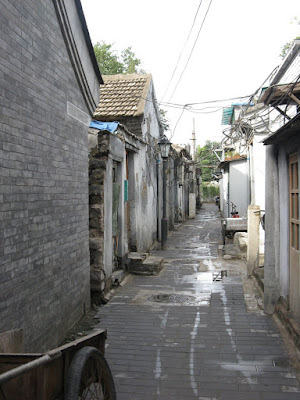
Leaving the Forbidden City behind, a stroll through one of Beijing's many Hutongs allowed us an insight into the everyday life of millions of Chinese:
The contrast of "old vs. new" was again clearly visible from the Beihai-park, with Beijing's highest skyscraper and the Coal Hill Pagoda side by side (at least they look like standing side by side):
A visit to the Summer Palace brought us back to the past splendor of the Chinese Empire, offering probably the most authentic experience in Beijing:
After a very tiring day (from visiting a lot of sites, finding our way on the chaotic streets of Beijing and trying to make ourselves understandable to Chinese taxi drivers speaking no English at all), we had our well deserved dinner, the Beijing Duck (pekingi kacsa):
It was time then to say goodbye to Beijing and board our train to Xi-An from probably the biggest railway station we have ever seen:
All our pictures from Beijing
Of course this does not change the fact that the sites are amazing, just don't fantasize on strolling the streets of Beijing in peace and quiet and have a romantic dinner on a street terrace like you would in Europe.
One of the most iconic site of Beijing is the Temple of Heaven. The complex situated in a huge park offers a nice refuge from the noise of the streets and an appropriate setting for this marvelous temple:
| From ASIA - CHINA - Beijing |
while at the same time offering ample space for people to do their daily exercise:
| From ASIA - CHINA - Beijing |
The visit of the Olympic park was a great contrast to the "old Beijing", where two of the most amazing sport venues of the 2008 Olympics are not to be missed:
- the "swiss designed" Bird's Nest:
| From ASIA - CHINA - Beijing |
- and the Watercube
| From ASIA - CHINA - Beijing |
Also part of the modern Beijing is the new National Grand Theater near Tienanmen Square:
| From ASIA - CHINA - Beijing |
The next day, after a quick "snack" on the way...
| From ASIA - CHINA - Beijing |
...we visited the now not so forbidden, but quite a city. After walking under Mao’s watchful gaze we found ourselves in a court yard, which looked more like a vast square surrounded by red walls and crowded with people. We stepped in to the Forbidden City…
| From ASIA - CHINA - Beijing |
The spacious Outer Court is filled with gigantic open squares, massive yet ornamented buildings that once housed the palace and official buildings. Behind the walls, the Inner Court, a vast labyrinth of inter-connected courtyards and buildings, which once served as the living quarter for the Imperial family.
Leaving the Forbidden City behind, a stroll through one of Beijing's many Hutongs allowed us an insight into the everyday life of millions of Chinese:
| From ASIA - CHINA - Beijing |
The contrast of "old vs. new" was again clearly visible from the Beihai-park, with Beijing's highest skyscraper and the Coal Hill Pagoda side by side (at least they look like standing side by side):
| From ASIA - CHINA - Beijing |
A visit to the Summer Palace brought us back to the past splendor of the Chinese Empire, offering probably the most authentic experience in Beijing:
| From ASIA - CHINA - Beijing |
After a very tiring day (from visiting a lot of sites, finding our way on the chaotic streets of Beijing and trying to make ourselves understandable to Chinese taxi drivers speaking no English at all), we had our well deserved dinner, the Beijing Duck (pekingi kacsa):
| From ASIA - CHINA - Beijing |
It was time then to say goodbye to Beijing and board our train to Xi-An from probably the biggest railway station we have ever seen:
| From ASIA - CHINA - Beijing |
Location:
Beijing, China
Sunday, September 19, 2010
A day in the watertown Suzhou
After we flew like a bullet with 350kmh in the bullet train (while watching the results of the beautification project with newly-planted trees all the way along the train tracks which were attempting to hide the dirt, smog and poverty behind)
we arrived in the beautiful watertown of Suzhou.
We started off by visiting the most famous site, the North Hill Pagoda, where we climbed hundreds of stairs to the 8th floor of the pagoda to catch a bird's eye view of the surrounding parks and canals. Meantime, Gulliver had a "belly contest" with the biggest Happy Buddha:
- we let our readers decide who the winner was...
After a stroll on the streets of Suzhou
...we changed means of transport and cruised on the picturesque canals:
Suzhou has a large network of canals running through the city; along the canal, some luxorious homes and typical third-world neighbourhoods standing side by side, with some pagodas and skyscrapers in the background - a remarkable contrast between modern and very old, clean and very dirty, traditional and transitional. We had lunch in the market-area of town that housed a countless stalls, carts, and little stores selling fruit, meat, shoes, household goods... everything.
There, at the crappiest-looking and probably the cheapest restaurant we have been to, we had the best Chinese lunch during our entire trip in China. It was part of our adventure that the restaurant only had Chinese menu, so we made our choice just by pointing on two of the dishes...
Krisztina took care of our dessert afterward:
... and with stuffed bellies (we could have entered now the belly contest with Gulliver and the Happy Buddha) we headed for the Tiger Hill Pagoda, our last destination in Suzhou:
All our pcitures from Suzhou.
| From ASIA - CHINA - Shanghai |
we arrived in the beautiful watertown of Suzhou.
We started off by visiting the most famous site, the North Hill Pagoda, where we climbed hundreds of stairs to the 8th floor of the pagoda to catch a bird's eye view of the surrounding parks and canals. Meantime, Gulliver had a "belly contest" with the biggest Happy Buddha:
| From ASIA - CHINA - Shanghai |
After a stroll on the streets of Suzhou
| From ASIA - CHINA - Shanghai |
...we changed means of transport and cruised on the picturesque canals:
| From ASIA - CHINA - Shanghai |
Suzhou has a large network of canals running through the city; along the canal, some luxorious homes and typical third-world neighbourhoods standing side by side, with some pagodas and skyscrapers in the background - a remarkable contrast between modern and very old, clean and very dirty, traditional and transitional. We had lunch in the market-area of town that housed a countless stalls, carts, and little stores selling fruit, meat, shoes, household goods... everything.
There, at the crappiest-looking and probably the cheapest restaurant we have been to, we had the best Chinese lunch during our entire trip in China. It was part of our adventure that the restaurant only had Chinese menu, so we made our choice just by pointing on two of the dishes...
Krisztina took care of our dessert afterward:
| From ASIA - CHINA - Shanghai |
... and with stuffed bellies (we could have entered now the belly contest with Gulliver and the Happy Buddha) we headed for the Tiger Hill Pagoda, our last destination in Suzhou:
| From ASIA - CHINA - Shanghai |
All our pcitures from Suzhou.
Saturday, September 18, 2010
Shanghai - "Chinese capitalism"
We started our great Far East journey in Shanghai, with the thought that it would be an approachable start to what was ahead of us... and it turned out to be just that: a sort of capitalism with apparent wealthiness, if you don't look behind the curtains...
First of all Shanghai impresses, Big Time! Already when getting from the airport to the city:
Flashy, Western-style advertising everywhere—billboards, benches, TVs and posters. Except for the Chinese characters on signs and the inevitable observation that everyone is Chinese, what you see in Shangahi could be anywhere in the West. Street vendors sell lots of low-quality goods really cheap, including very real-looking copies of iPhones. New wealth is seem to be shown with driving around in brand new Audi's or Mercedes, but having little or no care for pedestrians attempting to cross the street at green light.
The financial district felt a little like Singapore, with skyscrapers competing with each other, relative clean streets and organized traffic:
At night we decided to look DOWN on the Pudong for a change (instead of having a sore neck from looking up to the skyscrapers) and went for some drinks to the 93rd floor of the highest building in China:
Side Note: BTW that little colorful tower DOWN there is 468.0 m high :-)
The Bund on the other hand is the reminiscent of the British, with European style buildings on the banks of the river - mixed with just a few modern but stylish skyscrapers, which however tend to blend in just as if they were always there:
As we made our way more into the heart of the city away from the financial center, we faced masses of people when the light at a pedestrian crossing on Nanjing road turned green (which by the way we though we were ready for, but this felt more like as if they were coming from a Lady Gaga concert or such):
With a brave attempt to buy a pair of sandals for Zoli we entered some of the shopping malls on the Nanjing road... although Shaghai's probably most popular shopping street, we had a real hard time finding what we were looking for, even though we decided to compromise on quality. Guess what, the main issue was the size. 45? No, noooo! No. It seemed to be a giant's foot size in China.
Heading to the Nanshi district, we were presented a blend of the picture-book traditional China and American fast-food culture,
but of course it takes only a little effort to find the "real" China we were looking for:
Blending with the locals, we had one of the best meals in China (after figuring out their system and learning how to use chopsticks):
With full stomach we headed for even more "real China" and visited a traditional Chinese Garden, an oasis in the middle of this modern metropolis:
All our pictures from Shanghai.
First of all Shanghai impresses, Big Time! Already when getting from the airport to the city:
![]() |
| From ASIA - CHINA - Shanghai |
Flashy, Western-style advertising everywhere—billboards, benches, TVs and posters. Except for the Chinese characters on signs and the inevitable observation that everyone is Chinese, what you see in Shangahi could be anywhere in the West. Street vendors sell lots of low-quality goods really cheap, including very real-looking copies of iPhones. New wealth is seem to be shown with driving around in brand new Audi's or Mercedes, but having little or no care for pedestrians attempting to cross the street at green light.
The financial district felt a little like Singapore, with skyscrapers competing with each other, relative clean streets and organized traffic:
| From ASIA - CHINA - Shanghai |
At night we decided to look DOWN on the Pudong for a change (instead of having a sore neck from looking up to the skyscrapers) and went for some drinks to the 93rd floor of the highest building in China:
| From ASIA - CHINA - Shanghai |
The Bund on the other hand is the reminiscent of the British, with European style buildings on the banks of the river - mixed with just a few modern but stylish skyscrapers, which however tend to blend in just as if they were always there:
| From ASIA - CHINA - Shanghai |
As we made our way more into the heart of the city away from the financial center, we faced masses of people when the light at a pedestrian crossing on Nanjing road turned green (which by the way we though we were ready for, but this felt more like as if they were coming from a Lady Gaga concert or such):
| From ASIA - CHINA - Shanghai |
With a brave attempt to buy a pair of sandals for Zoli we entered some of the shopping malls on the Nanjing road... although Shaghai's probably most popular shopping street, we had a real hard time finding what we were looking for, even though we decided to compromise on quality. Guess what, the main issue was the size. 45? No, noooo! No. It seemed to be a giant's foot size in China.
Heading to the Nanshi district, we were presented a blend of the picture-book traditional China and American fast-food culture,
| From ASIA - CHINA - Shanghai |
but of course it takes only a little effort to find the "real" China we were looking for:
| From ASIA - CHINA - Shanghai |
Blending with the locals, we had one of the best meals in China (after figuring out their system and learning how to use chopsticks):
| From ASIA - CHINA - Shanghai |
With full stomach we headed for even more "real China" and visited a traditional Chinese Garden, an oasis in the middle of this modern metropolis:
| From ASIA - CHINA - Shanghai |
All our pictures from Shanghai.
Location:
Shanghai, China
Subscribe to:
Posts (Atom)